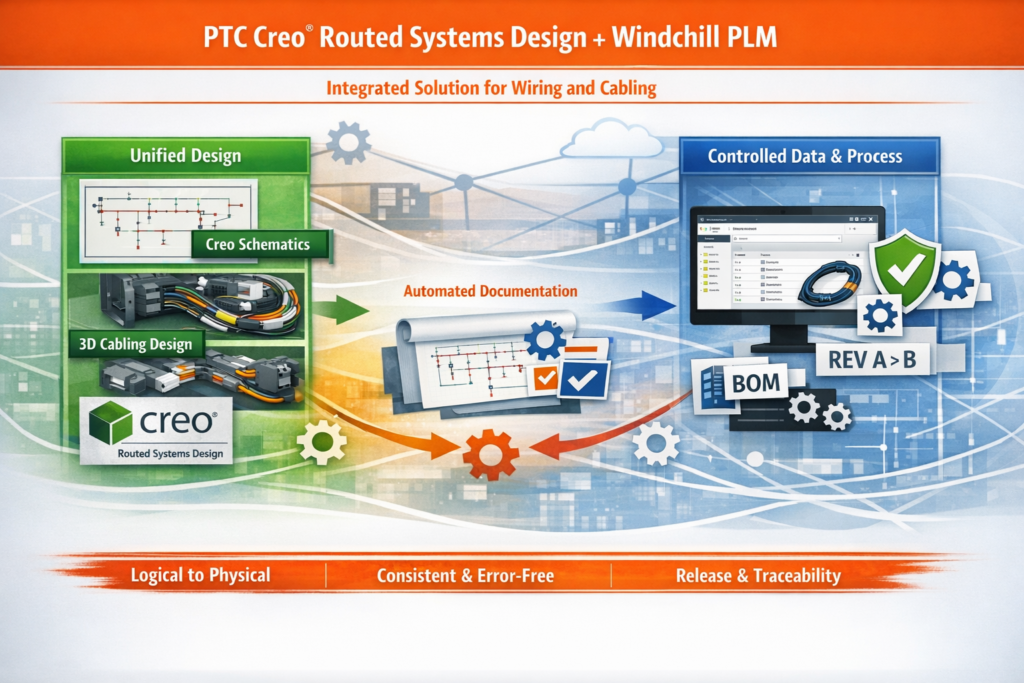
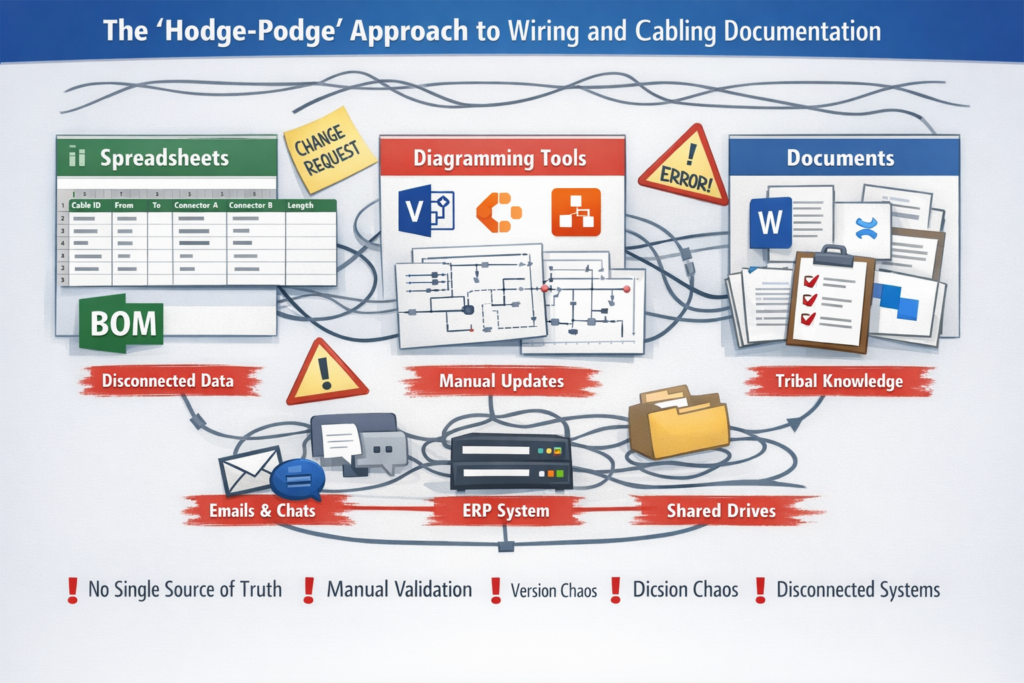
Teams relying on Excel, Visio, and Word for wiring and harness documentation experience unavoidable data drift, weak validation, and costly rework. PTC Creo Routed Systems Design delivers an integrated, model-based workflow that connects logical intent, 3D routing, and manufacturing outputs. Integrated with Windchill PLM, routed-system definitions become governed, traceable, and scalable across the enterprise.
Word / Confluence / PDF: work instructions and installation steps
Email / Teams / shared drives: change coordination and tribal knowledge
ERP-only BOMs: procurement data disconnected from engineering intent
This approach is fast to start—but fundamentally data-fragmented by design.
Issues & Drawbacks
01
No Single Source of Truth
Different systems become the master for manufacturing, installation, and procurement. The same cable or harness effectively has multiple competing definitions.
02
Weak Change Control & Revision Integrity
File versioning is not configuration control. Manual propagation of changes introduces delay, inconsistency, and risk. Windchill addresses this with controlled release, traceability, and secure collaboration.
03
Error‑Prone Connectivity and Manual Validation
Spreadsheets and drawings cannot automatically validate connectivity, pin integrity, grounding, or connector compatibility. Creo Routed Systems Design enables automated validation of routed systems to reduce late-stage errors.
04
Documentation and BOM Drift
Updates to cable lengths or components require manual updates across drawings, BOMs, and instructions—leading to drift. Routed Systems Design enforces associativity by design.
05
Limited Manufacturing Deliverables
Flattened harnesses and nail boards are often handcrafted or skipped entirely. Harness Manufacturing Extension (HMX) automates these deliverables and keeps them in sync.
06
Poor Scalability and Collaboration
Product variants and global teams multiply complexity. Windchill provides configuration management and role-based collaboration at scale.
Creo Routed Systems Design
What Is PTC Creo Routed Systems Design?
Creo Routed Systems Design is PTC’s solution for cabling, piping, and harness design—from concept through manufacturing documentation.
Routed Systems Design provides authoring and validation, while Windchill PLM serves as the enterprise control plane—enabling governance and the digital thread.
Windchill enables:
Centralized, traceable product data
Secure collaboration across distributed teams
Configuration management and controlled releases
Key Business Benefits
Reduced errors, rework, and late-stage changes
Faster time-to-market through automation and associativity