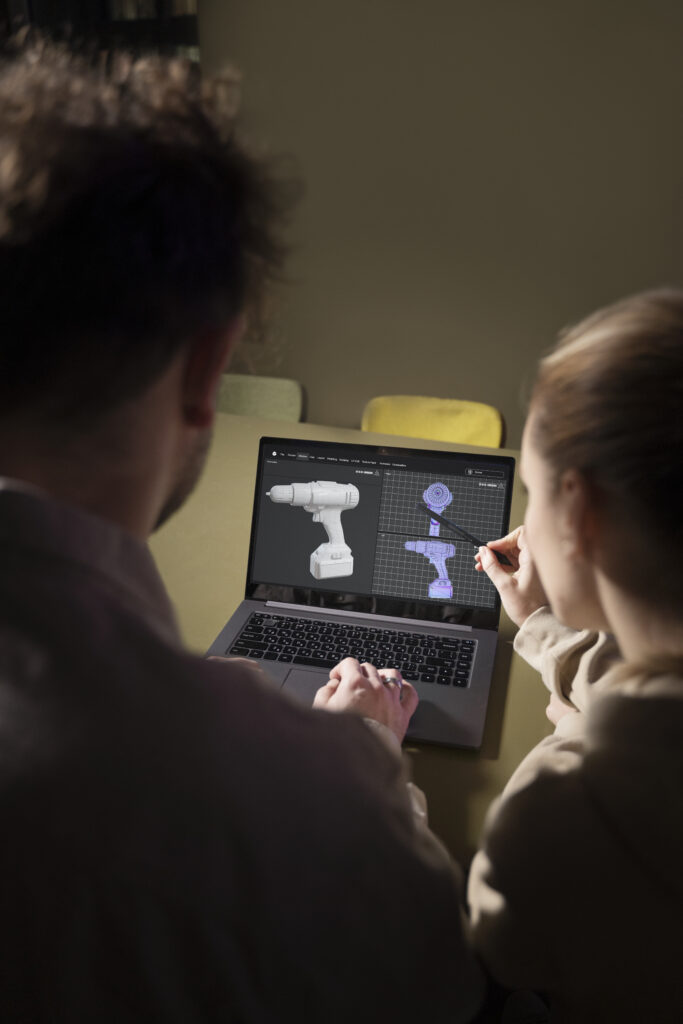


Creo by PTC is a powerful parametric 3D CAD system designed to help product design and manufacturing teams deliver their best work—faster and more efficiently. In today’s competitive landscape, teams are expected to innovate without compromising quality or cost-effectiveness. Creo rises to the challenge with the most scalable range of 3D CAD product development packages and tools available.
Manufacturers rely on Creo for its fully integrated capabilities across design, simulation, and manufacturing. From concept to digital prototype, Creo enables intuitive, precise, and efficient product development with model-based design, real-time simulation, generative design, and streamlined workflows for composites, additive, and subtractive manufacturing. Its easy-to-use core modeling tools improve productivity daily, and its fully associative nature ensures that changes are automatically propagated across the value chain.
Whether you choose Creo’s on-premises solution or Creo+ for cloud-enabled collaboration and SaaS-based license management, you’ll benefit from a cutting-edge CAD platform that’s been driving innovation for decades.
PTC stands out among its competitors in the MCAD SaaS space for large enterprises and industrial-scale manufacturing, particularly in innovation and implementation. Here’s a breakdown of how PTC compares:
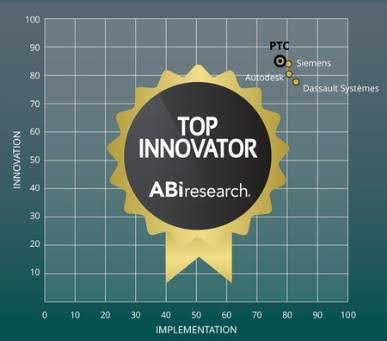
PTC’s Creo is a powerful suite of CAD, CAM, and CAE tools that supports the entire product development lifecycle. With breakthrough capabilities in Additive Manufacturing, IoT, Model-Based Definition (MBD), and Augmented Reality (AR), Creo empowers users to design faster and smarter by seamlessly connecting digital designs to physical products—transforming the way innovation happens.

Artificial Intelligence is transforming CAD by augmenting—not replacing—engineering expertise. AI‑driven CAD tools automate repetitive tasks, optimize designs, and predict potential issues early in the design cycle, allowing engineers to focus on creativity, innovation, and problem‑solving. Advanced capabilities such as generative design, AI‑powered simulations, and predictive analytics enable rapid evaluation of multiple design scenarios, reducing reliance on physical prototypes while improving accuracy, efficiency, and time‑to‑market.
When integrated into platforms like PTC Creo, AI enhances collaboration, supports data‑driven decision‑making, and delivers unprecedented levels of precision and productivity. AI also plays a growing role in sustainability by optimizing material usage, minimizing waste, and evaluating environmental impact during design. While challenges such as data quality, user adoption, scalability, and ethical considerations must be managed carefully, AI in CAD represents a critical advancement in modern product development—empowering engineering teams to deliver higher‑quality designs faster and more responsibly.

Many organizations produce wiring and cabling documentation using a patchwork of spreadsheets (Excel / Google Sheets for Cable schedules, Wire lists, Harness pin‑to‑pin tables, Connector definitions, Cable lengths and labels, Flattened Bills of Materials (BOMs), diagramming tools (Visio/Lucid/draw.io for schematics, block diagrams, cable routing overviews, harness overviews, and installation guides), and documents (Word/Confluence/Markdown/ for wiring instructions, installation procedures, cable labeling rules, connector pinout tables, and harness build instructions). This approach can work for simple products, but it becomes increasingly fragile as product complexity, variants, compliance needs, and manufacturing rigor grow.
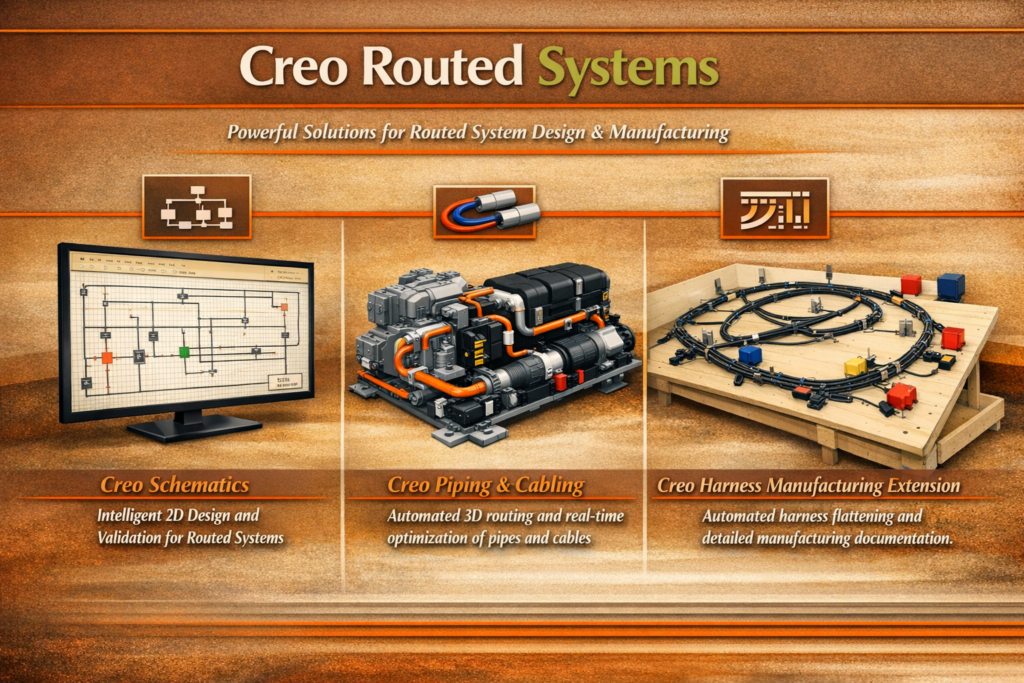
PTC’s Creo Routed Systems Design (RSD)—including Creo Schematics, Piping & Cabling Extension (PCX), and Harness Manufacturing Extension (HMX)—provides an integrated environment to define, model, validate, and manufacture document cabling and harnesses from concept through release. PTC positions Routed Systems Design as a suite that automates routed systems work (cabling/piping/harnesses) and improves cost, quality, and time to market.
When integrated with Windchill PLM, the result is a governed digital thread: controlled revisions, traceability, and a single, authoritative source for released product definitions and structures. Windchill is explicitly positioned as a platform for secure collaboration and multi-disciplinary data access, and as a foundation for a product-driven digital thread and integrations.
Move away from a “Hodge Podge” Documentation Stack to PTC Creo Routed Systems Design plus Windchill PLM to manage your wiring/cabling schematics, harness assembly drawings, cabling BOMs, and related deliverables.
TC Mathcad Prime is a powerful engineering mathematics software designed to streamline the process of solving, analyzing, documenting, and sharing technical calculations. It offers an intuitive interface that mimics textbook-style math notation, making it accessible for both novice and experienced engineers. The software supports unit-aware calculations, symbolic and numeric solving, and advanced plotting capabilities, ensuring precision and clarity in engineering workflows.
Mathcad Prime enhances productivity by enabling reusable templates, integrating seamlessly with tools like Creo, Windchill, and Excel, and supporting object linking and embedding (OLE) for dynamic documentation. Its features include optimization solvers, programming constructs, control structures, and rich formatting options that allow users to communicate design intent effectively. With its comprehensive unit system and visual tools, Mathcad Prime serves as a digital engineering notebook that bridges the gap between design and analysis.


Datafrond has developed a Solid Edge – PLM Connect for Siemens Solid Edge 2025 that provides integration between Windchill PLM and the Solid Edge MCAD application, allowing seamless management of CAD data within the Windchill database.
Key Functions:
This integration streamlines MCAD data handling, improving workflow efficiency and collaboration within product lifecycle management.
Many companies struggle to integrate electronics design (ECAD) with their broader business systems, especially their Windchill PLM platform. Engineers often deal with manual, time-consuming processes to upload ECAD data, leading to delays, disconnected information, and inefficiencies in collaboration.
The Solution: Automated ECAD-to-PLM Integration
By connecting ECAD directly to Windchill PLM, engineers can:
This integration streamlines workflows, eliminates manual uploads, and ensures efficient product development.

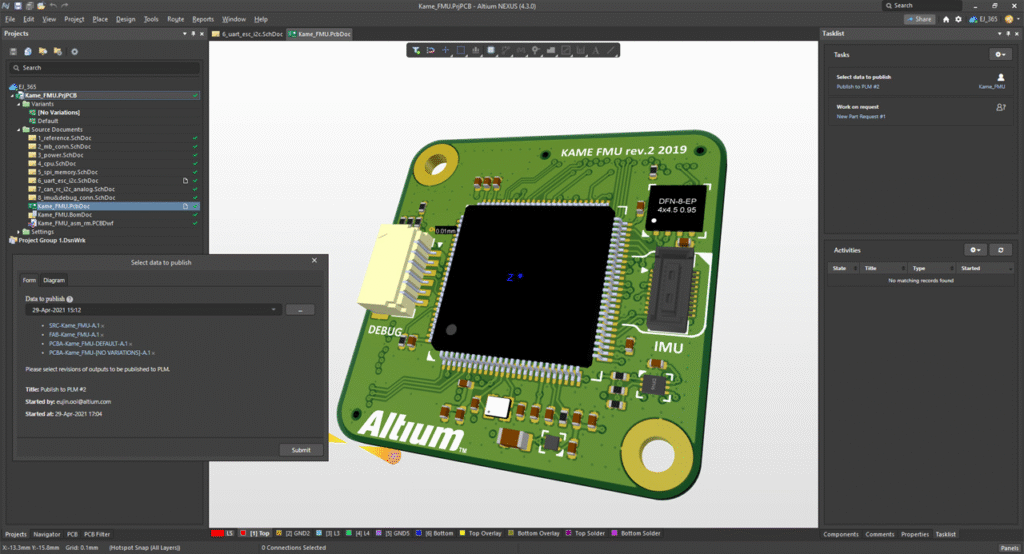
Altium’s Enterprise Server Integration connects the ECAD design process with PTC Windchill® and Arena® PLM to streamline design and component management.
What It Does:
This integration helps keep your design and manufacturing processes organized and efficient.
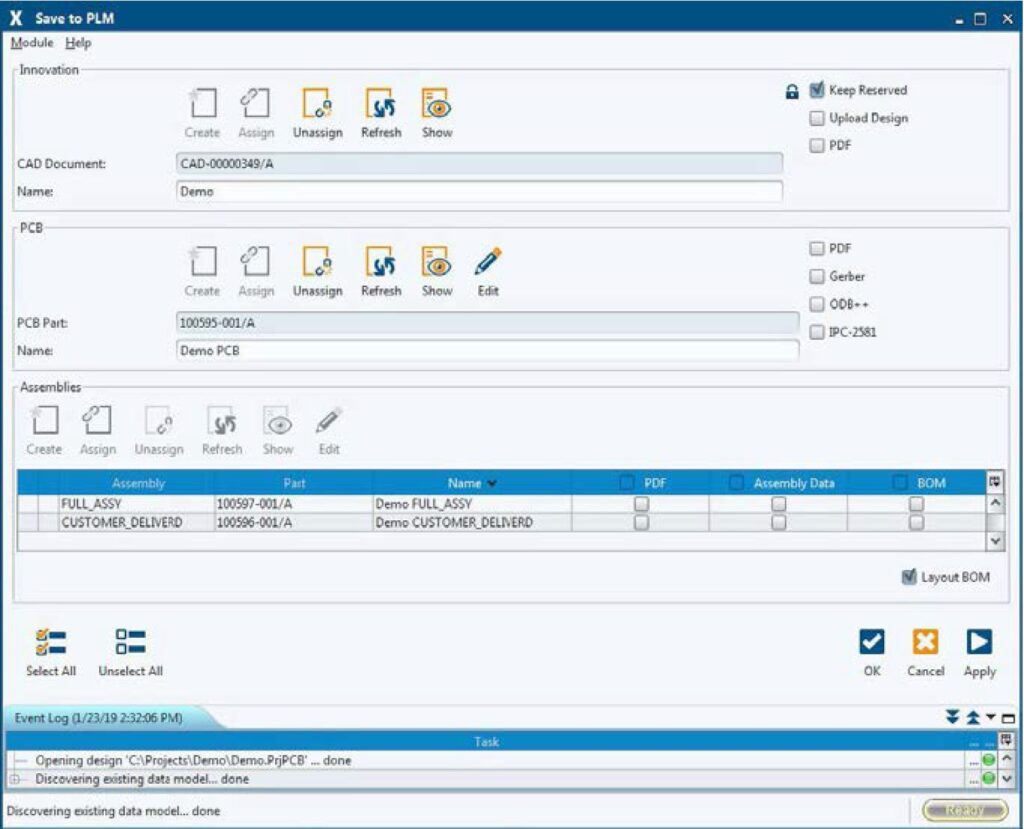
Developed by XPLM, integrate2 links Altium Designer Standard with PTC Windchill, enabling seamless collaboration across design teams. It unifies mechanical, electrical, software, and electronic design data on a single platform, making product development more efficient and reliable.
Key Benefits:
Additionally, integrate2 supports integrations for other ECAD tools like Cadence, Siemens, Pulsonix, Zuken, and AutoCAD Electrical.
Get the latest news, product updates, and unique perspectives delivered straight to your inbox. Join our growing community of savvy business leaders and professionals.